
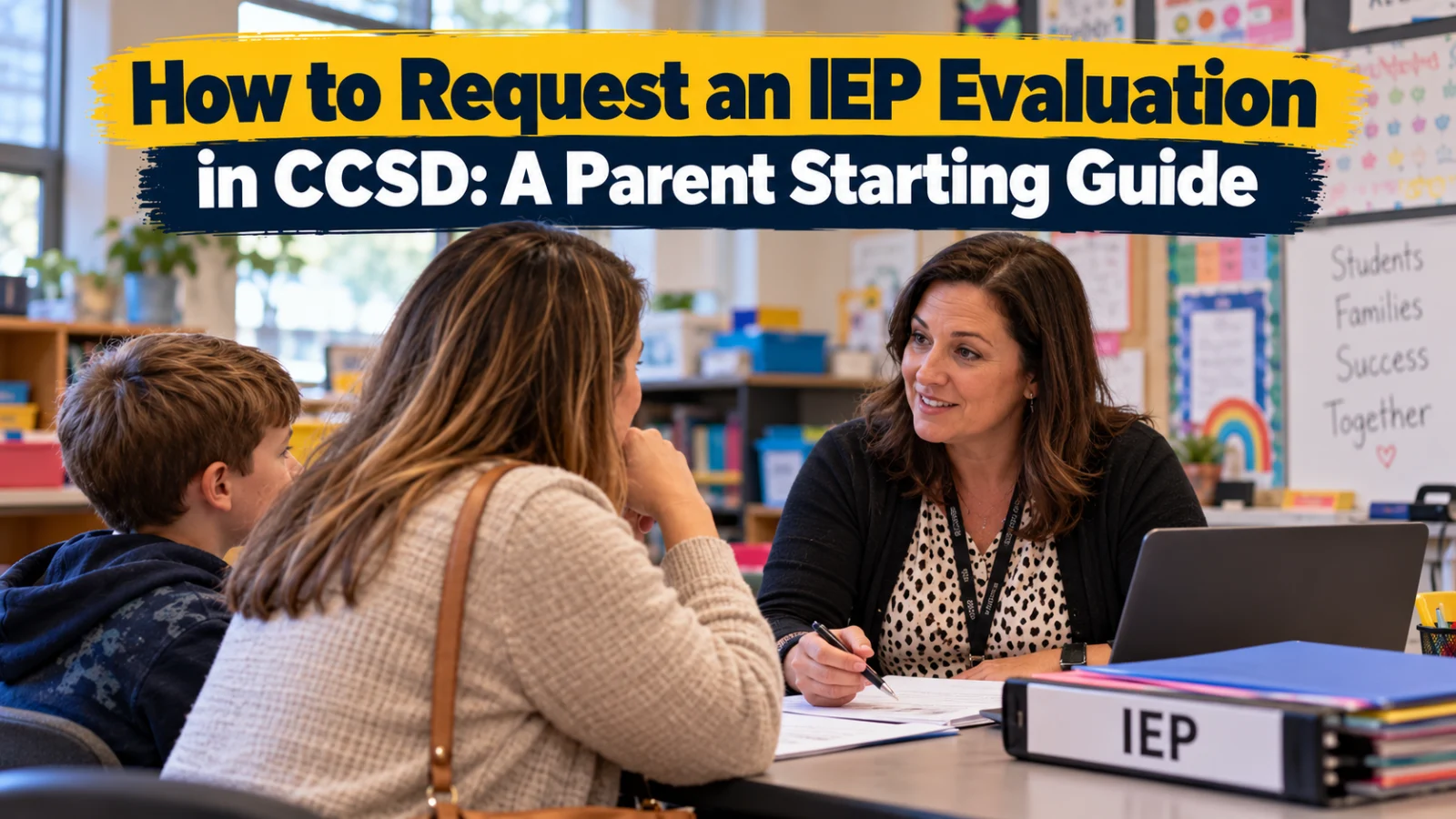
A spoken request counts, but a dated email is your proof. Here's a template to copy, what the testing covers, what you're signing, and what you can do if you disagree with the results.
A parent or guardian can ask Clark County School District for a special education evaluation at any time, verbally or in writing, and CCSD has ten calendar days to respond in writing. Both rules are in the district's Special Education Procedures Manual, the October 2026 edition linked from the Student Services Division site at ssd.ccsd.net (checked Tuesday, October 13, 2026).
An evaluation is the testing and review that decides whether a student qualifies for special education under the federal Individuals with Disabilities Education Act. An Individualized Education Program, or IEP, is the plan written after a student qualifies.
Making the request
Tell someone at your child's school. The manual lists several ways a parent can raise a suspected disability: request an evaluation, ask for an IEP, hand over medical documentation such as a doctor's note, or describe a family history of a disability. Any of those counts, and it can be spoken or written.
The manual tells staff to bring every request to the principal and the school psychologist immediately, and its timeline chart says to notify both the same day. Day one of the ten day clock is the day you make the request, and a dated email gives you your own record of it. The ten days are CCSD's own timeline from its manual, not a state or federal deadline. If day ten passes with no written answer, follow up in writing to the principal and copy the school psychologist.
Sample request email
Send it to the principal, copy the school psychologist and teacher, and fill in the brackets.
Subject: Request for special education evaluation for [child's full name]
Dear [Principal's name],
I am requesting a special education evaluation for my child, [full name], date of birth [date], student ID [number, if known], in [grade and teacher].
I am concerned about [describe in one or two sentences, for example: reading well below grade level despite small group help since September, and daily meltdowns about homework]. I have attached [a doctor's note, outside report, or recent work samples, if any].
Please send me your written response and tell me who on the team will be my contact.
Thank you,
[Your name, phone, email]
This wording is CCSD Insider's suggestion, not a district form.
Does asking guarantee testing?
No. The manual says a request from a parent, teacher, or administrator "alone does not automatically trigger a need for evaluation." What triggers the federal duty to evaluate is an informed suspicion that the student may qualify, drawn from data such as intervention progress, grades, or behavior.
Within those ten calendar days the school gathers information. The manual's timeline includes a parent interview, a records review, and teacher interviews. Then the school sends one of two answers:
A Prior Written Notice proposing an evaluation, followed by a consent form for you to sign.
A Parental Prior Notice of District Refusal (form CCF 567 or 567.1), when the team decides an evaluation isn't warranted, for example because it wants to try interventions first.
The school can also schedule a meeting of the multidisciplinary team to address the concern. If you get a refusal, the notice is the document to keep. Your procedural rights, including how to disagree, are in the state's Special Education Rights of Parents and Students, linked in English and Spanish from the Student Services Division home page.
What the consent form covers
Federal rule 34 CFR 300.300 requires the district to give you notice and get your informed consent before an initial evaluation. It also says that consent to evaluate is not consent to special education services. The CCSD manual (chapter 7.2) says informed consent means:
You were told everything relevant in your native language or other mode of communication.
You agreed in writing to the action the form describes, including any records to be released and to whom.
You understand consent is voluntary and can be withdrawn at any time.
CCSD does not accept partial consent, so your signature covers every new assessment the team needs, not just the ones you pick.
Before you sign, check that every concern you raised, such as speech or behavior, appears in the areas listed.
What if you don't sign?
Then there is no evaluation unless the district acts. Under 34 CFR 300.300(a)(3), if a parent refuses or doesn't respond, the district may, but is not required to, pursue the evaluation through mediation or a due process hearing. If it chooses not to, it has not violated its duty to find and evaluate children.
What the evaluation includes
The manual's chapter 9.5 says the team must assess your child "in all areas related to the suspected disability including, if appropriate, health, vision, hearing, social and emotional status, general intelligence, academic performance, communicative status, and motor abilities." It must be broad enough to find all of your child's needs, not just those tied to one disability category.
Who does the testing depends on the concern. The written evaluation report may draw on general and special education teachers, a school psychologist, a speech language pathologist, a school nurse, an occupational therapist, a physical therapist, and other staff. The school psychologist leads the report, except when the suspected disability is a speech and language impairment. In that case the speech language pathologist leads.
The 45 school day clock
The clock starts when you sign consent. Nevada's NAC 388.337 requires the initial evaluation within 45 school days after the parent gives informed written consent. The CCSD manual sets the eligibility meeting inside that same 45 school day window.
School days are not calendar days, so winter and spring break don't count.
The state superintendent can extend the deadline by up to 15 school days at the district's request, and a parent and the district can agree in writing to a different date. The deadline also does not apply if a parent repeatedly does not bring the student for testing.
At the eligibility meeting, the manual says the parent gets a copy of the completed evaluation reports and eligibility statements that same day. If your child qualifies and you consent to services, the IEP must be developed within 30 calendar days of the eligibility decision.
Eligibility meeting: what to bring and ask
The multidisciplinary team, or MDT, decides eligibility, and you are a member of it. At least three people must attend, and decisions are made by consensus. The team can meet without you only after documented reasonable efforts to get you there, so answer the meeting notice.
To qualify, your child needs one of the 13 disabilities listed in the manual's chapter 9.7.1 and must need special education because of it. The manual says a student is not eligible if the team finds a disability but no need for special education.
Bring:
Your copy of the consent form and any notices.
Outside medical, therapy, or private testing reports.
Recent work samples and report cards.
Ask:
Which eligibility category is the team considering, and which data supports it?
Were all the areas I raised assessed? If not, why not?
If my child qualifies, when is the IEP meeting? The manual allows it to be held the same day.
If my child doesn't qualify, should we look at a Section 504 Plan?
IEP or 504 plan?
An IEP comes from the Individuals with Disabilities Education Act and requires a disability plus, as the manual's chapter 9.7 puts it, a need for special education and related services. A Section 504 Plan comes from Section 504 of the Rehabilitation Act of 1973. CCSD's Section 504 Plans site describes it as accommodations, "such as extended time on tests or access to audiobooks," for students whose impairment substantially limits a major life activity.
The same site says a 504 evaluation does not necessarily involve formal testing. It reviews current data such as school records and teacher and parent reports. A diagnosis alone, including ADHD, doesn't guarantee eligibility. To start a 504, the site says to contact the Section 504 liaison at your child's school, since every CCSD school has one.
If you disagree with the results
You can ask for an independent educational evaluation, or IEE, by a qualified examiner who doesn't work for CCSD. Under 34 CFR 300.502, the district must then, without unnecessary delay, either pay for the IEE or file for a due process hearing to show its own evaluation was appropriate. You get one publicly funded IEE each time you disagree with a district evaluation. You may ask verbally or in writing. You may be asked your reasons, but you don't have to give them. The school must send your request to the director of Psychological Services within two school days, and you get a written decision within 15 business days.
Preschoolers, homeschoolers, and private school students
Go to the Child Find Project instead of a school office. The Child Find page says it evaluates preschool age children who are not already enrolled in school, and school age children who are homeschooled or enrolled in private schools and live in Clark County. Evaluations for school age children happen at the attendance zoned school. To start, complete the Child Find Registration and send the required documents to childfind@nv.ccsd.net.
Contacts
Your child's principal or school psychologist first, for any student enrolled in a CCSD school. For a 504 Plan, your school's Section 504 liaison.
Nevada PEP (Parents Encouraging Parents), which offers families of children with disabilities individual help on its Get Help page: 702 388 8899 in Las Vegas, 800 216 5188 statewide, PEPInfo@NVPEP.org, 7211 W. Charleston Blvd., Las Vegas, NV 89117.
Child Find Project: 702 799 7463, childfind@nv.ccsd.net, 2625 E. St. Louis Avenue, Las Vegas, NV 89104.
Student Services Division: 4170 McLeod Drive, Las Vegas, NV 89121.