
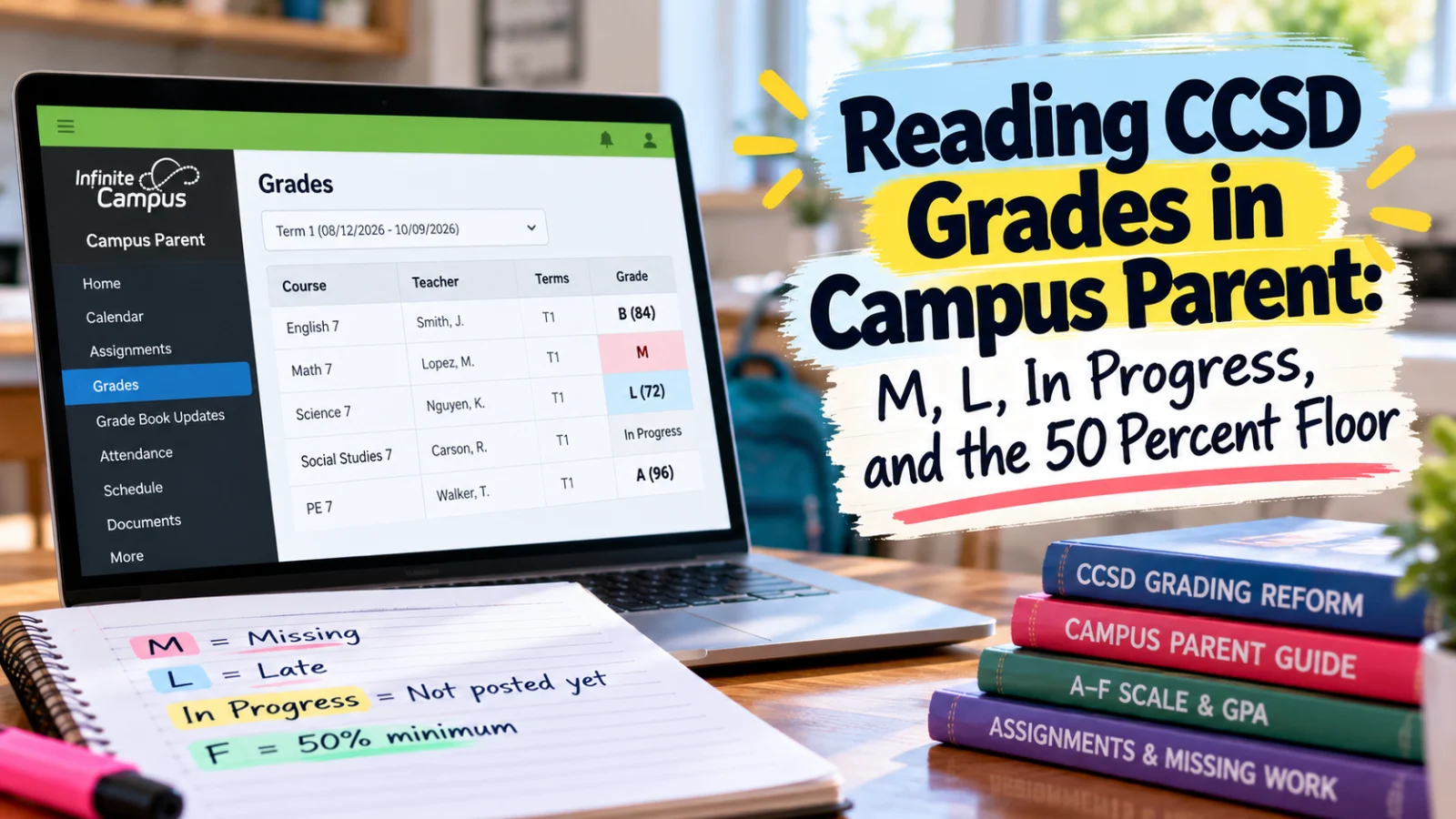
An "M" in the CCSD grade book counts as 50 percent in elementary school and 0 percent in middle and high school.
The first grading period of 2026 to 2027 closed Friday, October 9, on Clark County School District's student calendar, and the next one ends Friday, December 18. Between those dates, the Grades tool in Campus Parent is showing work in progress, and the letters and flags on it follow district rules that changed with grading reform. This walk through uses Regulation 5121, last revised July 8, 2021, and the district's Grading Reform Initiative page, both checked Saturday, October 17, 2026.
Bold or not bold
In the Grades tool, pick the term and then the course. The district's Campus Parent manual says "Posted grades display in bold" and grades that are not posted show as in progress. A grade in regular type in late October is a running number, not the report card grade.
For a quick weekly look, Grade Book Updates lists everything scored or updated in the last fourteen days, with Turned In, Late, or Missing flags.
What an "M" does to the average
When a student misses a deadline, the teacher enters an "M" as a placeholder. The grading reform FAQ says it is "calculated as 50 percent at the elementary level and as 0 percent at the secondary level."
Students facing barriers "may submit missing work within five school days without a score penalty," the same page says. When the work comes in, the M is replaced by the real score and an "L" late flag is added. The L is about behavior and does not lower the grade.
Each school sets that deadline, and the reform page calls for a "common school deadline (minimum of five school days)." If the work never arrives by the school's deadline and the teacher has not found other evidence of learning, the M stays. For a middle or high school student, that is a zero in the average.
What the teacher owes you on missing work
The district's Grading Guidelines, a 2023 to 2024 document still posted on the district's file server, spell out the teacher's side. CCSD had not posted a later version when we checked. Educators must notify students and families of missing work through Infinite Campus "in a timely manner (e.g., within three days of the missed due date)," state the deadline for accepting missing work, say plainly that missing work means 50 percent in elementary and 0 percent in secondary, and provide what the student needs to finish it, such as a copy of the classwork or rubric.
Teachers are also told to run a Missing Assignments Report on a regular basis, weekly as the example, and students with excessive missing work get extra academic or behavioral support through the school's Multi Tiered System of Supports.
Each school writes its own version. The 2026 to 2027 grading policy at Cortez Elementary, for example, accepts late work for two weeks after the due date. Ask your school for its posted policy if a deadline in the Grade Book surprises you.
Why the lowest F is 50
Regulation 5121 sets the same A through F scale for grades 1 through 12:
A is 90 to 100 percent, "Excellent."
B is 80 to 89 percent, "Above Average."
C is 70 to 79 percent, "Average."
D is 60 to 69 percent, "Below Average."
F is 50 to 59 percent, "Emergent."
The district calls this an equity scale with "a floor of 50" so each letter covers an equal range. That floor does not apply to a secondary M, which still counts as 0.
Grading reform also says "CCSD is NOT adopting a 'No Fail' policy."
How much does each test count?
Most of the grade comes from tests and projects. The reform page sets Grade Book weighting for 2023 and beyond at 0 to 20 percent formative and 80 to 100 percent summative. The guidelines define formative work as low stakes classwork, exit tickets, and quizzes, and summative work as unit tests, projects, presentations, performance tasks, and semester exams. District and state tests such as SBAC, ACT, and MAP Growth are not part of either category, so a low MAP score does not land in the grade.
A school's exact split must stay inside those ranges and be "clearly communicated by the school to students and families," the guidelines say. That split explains why one missed unit test moves an average far more than three missed worksheets.
Elementary marks
Kindergarten uses 2 for Meets and 1 for Approaches. Grades 1 through 5 use the letter scale plus "W," which means "Working on standards below grade level."
Other subjects can carry E for Exceptional Progress, S for Satisfactory Progress, and N for Needs Improvement. Schools using standards based reporting use 4 Exceeds, 3 Meets, 2 Approaches, and 1 Emergent.
Middle and high school marks
Grades 6 through 12 add GPA points, 4.0 for an A down to 0 for an F, and a "P" for passing in certain courses. Standards based courses can show 4 through 1 and also 0 for "No Evidence."
Two rules matter at semester time. Both quarters "must be equally weighted," and a high school credit course's semester exam can be worth no more than 20 percent of the final semester grade. That includes high school credit courses taken in middle school.
When do grading periods end this year?
The district student calendar lists four: Friday, October 9 (44 days), Friday, December 18 (45 days), Friday, March 12 (48 days), and Thursday, May 20 (43 days).
Behavior has its own line
Under Regulation 5121, grades "shall not be influenced by behavior or other nonacademic measures," and the regulation lists late or missing work, attendance, participation, and responsibility. On the report card, the reform page says behavior is reported under Successful Learner Behaviors for elementary students and Citizenship for secondary students.
Can a test be retaken?
Yes, once. The reform page says students get "one opportunity, per summative assessment," to reassess, and that AP and IB teachers keep flexibility. Smaller formative assignments are not part of it. The student works out a plan with the teacher first.
How do I challenge a final grade?
The regulation's process starts with the parent and must begin "within one semester after the issuance of the grade," with the student carrying the burden of proof. The principal reviews the teacher's justification within ten school days.
If the principal and teacher do not agree on the grade, the parent can appeal to the region superintendent within ten school days. A hearing is held within fifteen working days, and the decision comes within five working days after that. "This determination shall be final."
Who to ask
Questions about a specific grade go to the teacher or school counselor, per the district's Campus Parent FAQs. If you cannot get into Campus Parent at all, start with our login troubleshooting guide. Report card PDFs and where they sit are in our Campus Parent documents guide.