
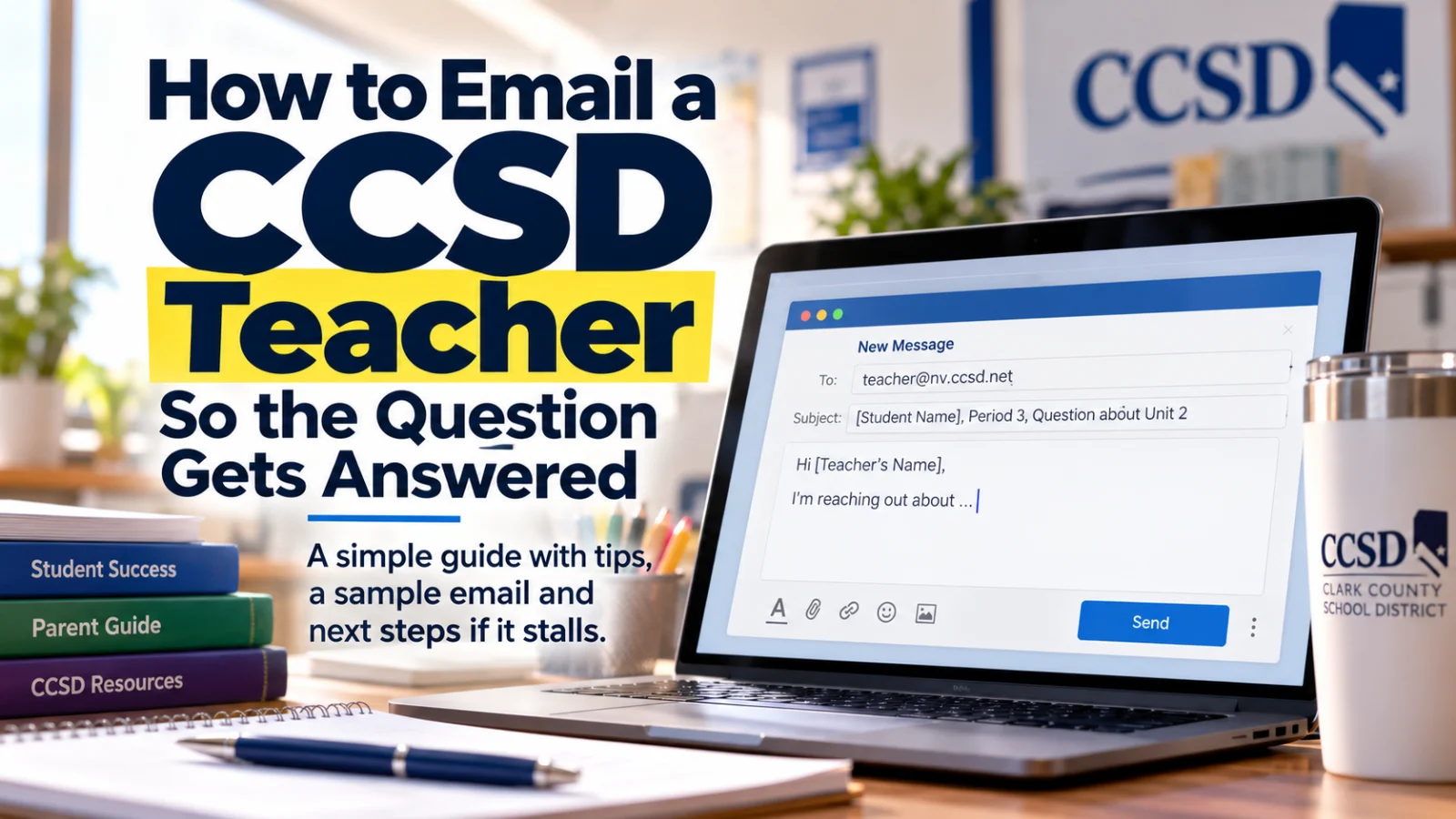
A CCSD regulation revised in June gives a teacher two business days to reach you about a concern and ten to answer it. Here is how to write that first email, and where to go if it stalls...
Clark County School District's rule for parent concerns starts with the classroom. If a concern involves a specific classroom or program, the parent "must contact the assigned teacher or other employee with the most direct connection to the concern," under Regulation 1213.1, revised June 25, 2026 (checked Saturday, October 17, 2026). The employee then has two business days to contact you by phone, email, or virtually, and must give a response within ten business days.
Where do I find my child's teacher's email address?
In Campus Parent. The district's Campus Parent/Student Portal and Mobile App Manual, dated January 2024, lists a Contact List under Quick Links as a "quick reference of contact information for student's teachers." The Message Center Inbox in the same portal "displays messages sent from teachers or school staff." Our Campus Parent guide covers logging in.
Check one setting while you are there. Under Settings, then Contact Preferences, the manual says a parent can set the phone numbers and email addresses the school uses, a preferred language, and Message Preferences, including the Teacher category. If teacher messages are switched off, replies sent through the portal can go unnoticed. The Campus Parent/Student FAQs say the portal itself is available in English, Spanish, and Chinese.
For a grade or progress question, the same FAQs say to contact the student's teacher or school counselor.
What to put in the email
One concern, the facts, and what you want to happen.
Put your child's full name and class period in the subject line. Then say what you saw, with the assignment name and date, and ask one question the teacher can answer.
Keep a second, unrelated issue for a second email. If the concern ever becomes a formal written concern, Regulation 1213.1 says that written concern "may only include information relevant to the original concern," and anything unrelated goes back to the start of the informal process.
Say how you want the reply. Regulation 1213.1 says CCSD employees should communicate "in the manner that is most convenient for the parent, guardian, or community member whenever possible (in person, via phone, or virtual)." If you work days and need a call after 4:00 p.m., write that.
A sample you can copy
This is our wording, not a district form. Swap in your details.
Subject: Jordan Lee, Period 3 Algebra I, missing grade for Unit 2 quiz
Hi Ms. Ramirez,
I'm Jordan Lee's mom. Campus Parent shows a 0 for the Unit 2 quiz from Tuesday, October 13. Jordan says he took it in class that day.
Could you check whether the quiz was turned in, and if not, whether he can make it up?
A reply by email works best for me. If a call is easier, I'm free after 4:00 p.m. at [your phone number].
Thank you,
Dana Lee
The subject line carries the name, class, and topic, so the teacher can find it later. The body states one fact, one question, and how to reach you.
What to leave out
A second complaint about a different class. Copies to the principal on a first message: Regulation 1213.1 sends a concern to the closest employee first, and lets a parent go to an administrator when that contact did not resolve it, would not be productive, or is about the teacher. Recordings, too. The regulation says no participant may record any contact, discussion, or conference in the concern process "without the express consent of all participants," except as the law requires.
How long does a CCSD teacher have to answer?
Two business days to contact you and ten business days to respond, under Regulation 1213.1. If the teacher needs more time to think it through, Regulation 1213.1 says the teacher has to tell you so. The ten business day limit still applies.
The clock pauses for leave and school breaks. If the employee is on approved leave or a school break, the timelines start when the employee returns to duty. If the teacher will be out more than ten business days, the regulation says you can call the school and ask for an alternate administrator to review the concern.
One more limit: if you and the teacher already reached a resolution on the same concern, the regulation lets the teacher refer you back to it.
When the teacher doesn't resolve it
Go to a school administrator. Regulation 1213.1 lets a parent bring the concern to a school administrator or the employee's direct supervisor when contacting the teacher did not resolve it, when contacting the teacher would not be productive, or when the concern is about the teacher. The administrator must contact you within two business days and tell you the outcome of the review, or that more time is needed, within three business days after that first contact.
Next comes the School Associate Superintendent, region administrator, or department head, on the same two and three business day timelines. The district's Resolution Process page links a school directory that lists each school's principal and School Associate Superintendent.
Some issues skip this ladder. The Resolution Process page lists law enforcement, discipline that results in suspension or alternative placement, discrimination based on race, bullying, and cyberbullying, special education, other discrimination matters such as sexual harassment, and transportation or bus concerns as having their own processes. For bullying, see our SafeVoice and bullying guide. For special education, Regulation 1213.1 says due process concerns go to the CCSD Office of Compliance and Monitoring or the Nevada Department of Education; our IEP evaluation guide covers the first request.
What does a Formal Written Concern involve?
After those informal steps, a parent may submit a written concern through the online customer service platform on ccsd.net, within 180 calendar days of when the parent knew or should have known of the incident, Regulation 1213.1 says. From there, the regulation sets these steps:
The Community Engagement Unit sends a written acknowledgment within two business days and checks that you went through the informal steps first. If you skipped them, it points you back.
Within 15 business days, the Region Superintendent or Chief contacts you to schedule a conference, in person, by phone, or virtually. If it is not resolved there, that office reviews records, interviews staff, and sends a brief written response with your appeal rights.
You have five business days from that response to appeal online to the Deputy Superintendent, with a detailed explanation of why you disagree.
The Deputy Superintendent or an assigned administrator issues a final, binding written decision within 15 business days, delivered through the online platform and by U.S. Mail.
The district does not reopen a concern that has reached a formal conclusion. A new concern about the same matter "will be closed with a reference to the original outcome," the regulation says.
Know what the process will not tell you. Personnel matters go through separate channels, and information gathered while investigating an employee is confidential. The regulation also notes the Board of School Trustees has no authority to discipline employees; that power belongs to the Superintendent and other administrators.
Beyond the school
Back to School says concerns not resolved at the school level may be addressed by calling 702 799 2273, where you will be directed to the right department. The CCSD Community Engagement Unit, which assists with Formal Written Concerns, is at 702 799 0072, the number Back to School lists for it (checked Friday, October 23, 2026). The Ask CCSD button on ccsd.net takes questions, comments, or concerns 24/7.