
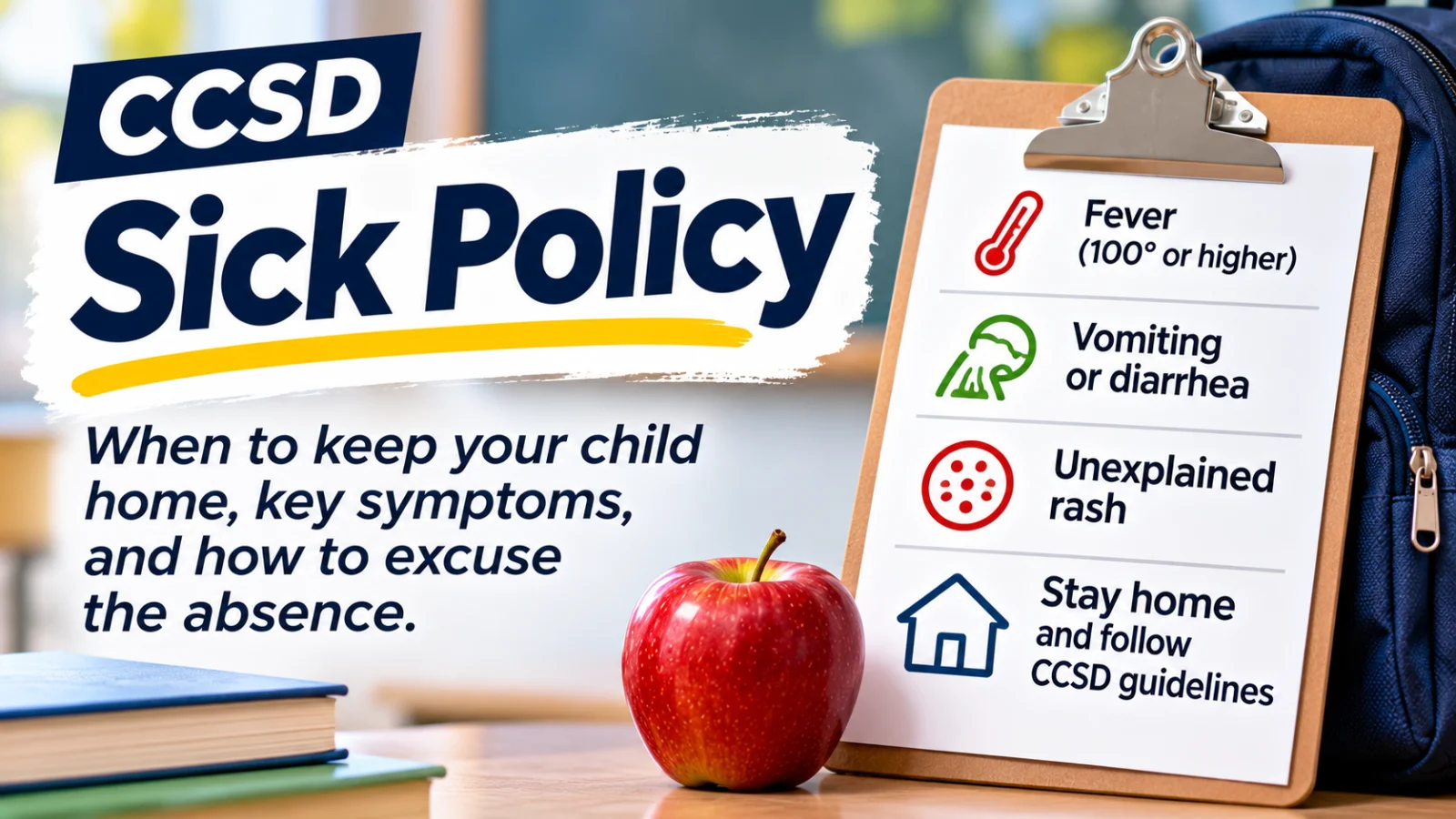
Clark County School District's rule for a sick child fits on one page. CCSD Health Services' parent handout, School Health Services: Information for Parents/Guardians (PUB-659, dated 7/23), says a child with a fever of "100 degrees or greater" should be kept home, and that your child must go 24 hours without a fever, without fever reducing medicine such as Tylenol or Advil, before returning to school.
That handout is still the version CCSD hosts as of Wednesday, November 4, 2026. School health office pages, including Harley A. Harmon Elementary's, post the same symptom list.
The symptoms that mean stay home
PUB-659 lists ten. If any one is present, the handout says, "your child should be kept home":
Fever of 100 degrees or greater
Unexplained vomiting or diarrhea
Unexplained rash
Persistent headache
Red or sore throat
Earache
Excessive coughing
Wheezing
Severe toothache
Untreated head lice
It adds that if symptoms last longer than 24 hours, "you may need to take your child to a LHCP." That's the district's shorthand for a licensed health care provider.
A child who woke with 101, got ibuprofen, and felt fine by lunch hasn't met the 24 hour rule. The clock starts when the fever is gone without medicine.
Contagious illness
Under a heading called Contagious Illnesses, PUB-659 says: "According to the Southern Nevada Health District, students with known or suspected contagious illnesses cannot come to school. The school nurse will provide guidance on when your child can return to school."
So for a contagious illness, the symptom list isn't the last word. The school nurse is.
The board regulation behind this is Regulation 5150, Health and Welfare: Students, last revised September 12, 2024. Section VI says the district works with the Southern Nevada Health District on communicable disease through its chief nurse. It also puts a duty on parents: a parent "shall not knowingly permit the student to attend school if the Board of School Trustees by regulation or procedure has determined that the communicable or infectious disease requires exclusion from school."
What the Southern Nevada Health District's own pages say
SNHD's disease pages are written mostly for the public and for child care, not for CCSD. A few speak to school directly.
Norovirus. The district's norovirus page gives two timelines in back to back sentences. Infected people "should stay home until 48 hours after symptoms have stopped." Then: "Children who are ill should be kept out of the childcare or school setting as long as diarrhea or vomiting is present." It puts school and child care workers on a longer, 72 hour clock.
Measles. SNHD's measles page, updated February 11, 2026, says isolating infected people "includes staying home from school, daycare or work." It asks you to call your doctor's office before you walk in with a child you suspect has measles.
Impetigo. SNHD's impetigo page addresses child care facilities: a child "can return after using antibiotic medication for 48 hours."
The 101 degree number. SNHD's child care regulations set exclusion at a temperature "at or above 101°F," and for children four months or older only when the fever comes with a change in behavior or other signs of illness. Those rules govern licensed child care facilities. CCSD's own handout uses 100 degrees for school. If your child goes to a child care center after school, expect the two places to use different cutoffs.
If your child gets sick at school
Regulation 5150 sets out what the school does. Staff may not send a student home "without school personnel first establishing the availability of adequate supervision in the home." And "School personnel should not transport sick or injured students. Parents/Guardians are responsible for the transport and welfare of their students."
In practice, that means the school calls. The regulation also says schools must keep "emergency phone numbers current at all times," and PUB-659 says the health information you enter in online registration carries over: "If the health information is not updated, the previous school year's information will be considered current." If your work number changed in October, update it now, not the day of a 102 fever.
For medicine during the day, the handout says every medication, prescription or over the counter, needs an order from your child's provider and a signed District Parent/Guardian Request for Medication Assistance form. Over the counter medicine has to be in its original container. Students in grades 6 through 12 may carry and take their own medicine with written parent permission, as long as it isn't a controlled substance, and that permission note must be on the student "at all times."
How to excuse a sick day
Illness is an approved absence. Regulation 5113, the attendance regulation last revised February 12, 2015, lists it first: the student "is physically or mentally unable to attend school."
CCSD's current Family Guide to School Attendance (PUB-688, revised 8/26) sets the deadline: written notice from a parent within three school days after the student returns from the absence. Nevada law, NRS 392.130, counts from the same point, "within 3 days after the pupil returns to school." Regulation 5113 words it two slightly different ways. Sending the note that morning meets every version.
The guide says the note should give your child's first and last name and student number, the dates missed, and the reason. If a doctor or other provider saw your child for the illness, it asks for the provider's documentation with your child's name, the dates, and the provider's contact information.
The note can come in writing or from you in person. Section V says the school "may reasonably inquire, investigate, and/or request further documentation." Each school's handbook sets its own readmittance procedure, so check yours for whether the front office wants a call, an email, or paper.
Miss the window and Section V lists the absence as unapproved.
Do sick days count against my child?
For credit and retention, documented ones mostly don't. Regulation 5113 sets limits of 20 absences a year in elementary school and 10 per semester in middle and high school. Its middle and high school section then says absences "due to the student's physical or mental inability to attend school, if properly documented and submitted to the school within the timelines defined by this regulation, will not be included in the determination of a student's denial of credit or retention," as long as the student has completed the required coursework.
That exception has three conditions: documented, on time, and the work done. Regulation 5123 says a middle or high school student with more than 10 unexcused absences in a course in one semester gets a failing semester grade and no credit for it, and PUB-688 says an absence without an explanation inside the three school days is unexcused.
When an illness lasts weeks
PUB-659 names two programs.
Homebound. Students "unable to attend school due to an injury, illness, or psychological disorder may be eligible for homebound services." Ask the school counselor, nurse, or psychologist.
Supplementary Home Services. Run by Auxiliary Instructional Services, it is "designed for all students with chronic illnesses who are likely to experience frequent intermittent absences throughout the school year." The handout says it supplements school, it doesn't replace it. Talk to your child's school team.
A chronic condition like asthma, diabetes, or migraines that keeps causing absences may also be grounds for a 504 Plan. Our 504 Plan vs. IEP explainer walks through how that request works.
Free sick visits for CCSD students
Health Services' Parent/Guardian Resources page lists the Clark County School District Family Support Center/UNLV Pediatric Family Support Center Clinic, offering "Pediatric sick visits, general care, and specialty care" to students ages 3 to 21 "at no cost." The same page lists Hazel Health telehealth, "Free for all Clark County School District students with or without insurance," and the C.P. Squires School-Based Health Center.
If a doctor's note is what your school wants, those are places to get one without a copay.
Who to call
Start with your school's health office or school nurse; PUB-659 sends return to school questions there. CCSD Student Health Services is at the Dr. Beth Howe Center, 3626 Pecos-McLeod Interconnect, Las Vegas, NV 89121, office 702 799 7443, according to its department page. For attendance help, the district's Attendance Resources page lists 702 799 2273. For disease questions, SNHD's impetigo page lists its Office of Epidemiology at 702 759 1300.
CCSD Insider is an independent parent resource and is not affiliated with the Clark County School District.